Made for product teams
Stop re-debating decisions you already made
Product decisions are made in meetings, debated in Slack, and then lost.
Fabric captures them automatically so you stop re-debating what was already resolved.
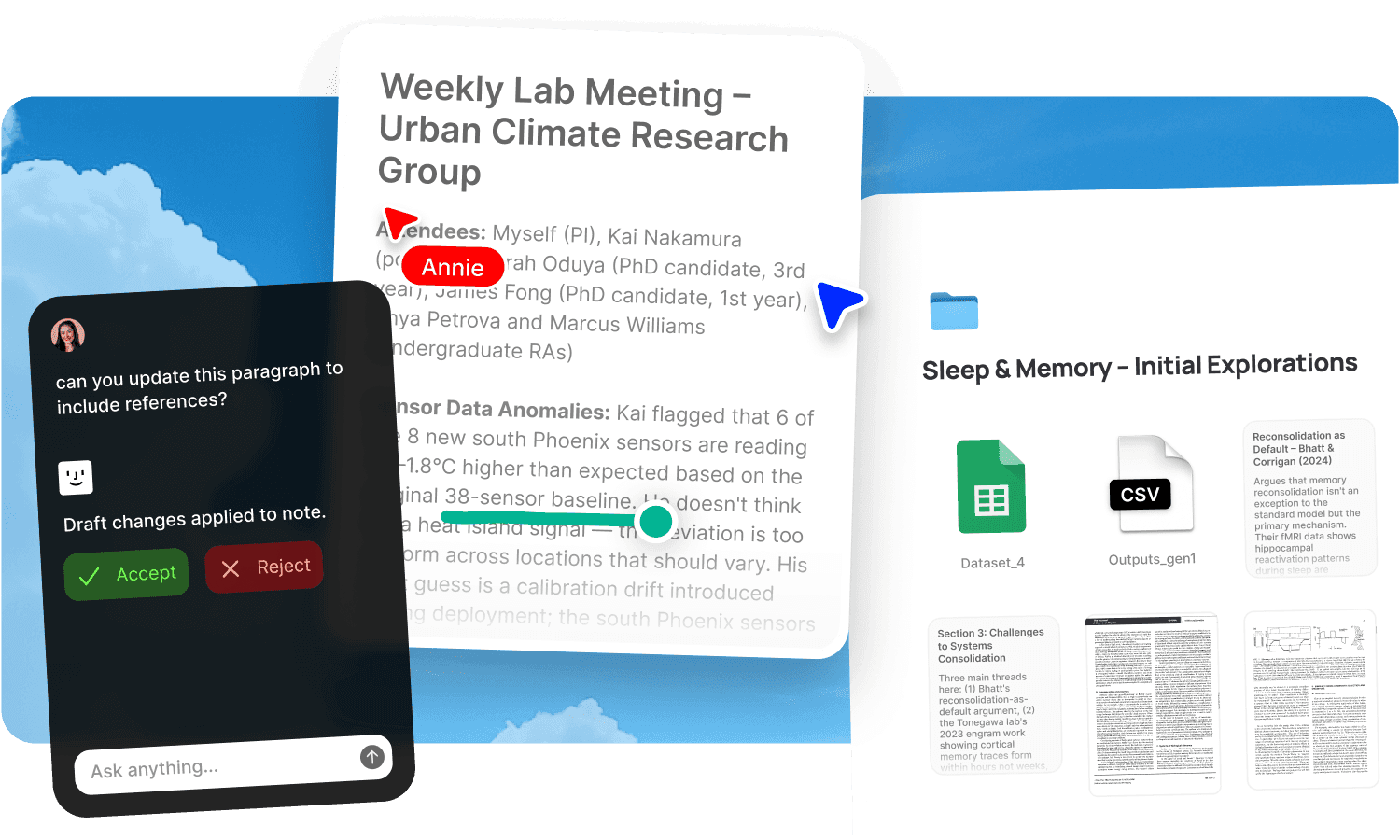
Product decisions are made in meetings, debated in Slack, and then lost. Two months later the same question gets re-debated because nobody can find what was already resolved. The PM remembers the outcome but not the reasoning. The designer remembers the reasoning but not who had the final say. The engineer remembers being told to build it but not why the alternative was rejected. The decision existed, clearly, at one point. Now it's a vague collective memory that doesn't hold up when someone new joins the team and asks "why do we do it this way."
Fabric connects to your communication, project management, and meeting tools, and captures product decisions as they happen. Self-writing docs produce the decision records nobody has time to maintain. AI search finds the answer instantly. Agents close the loop between decisions and execution.
Self-writing product docs
Self-writing docs connect to your Slack and meetings and produce the documentation product teams need but never have time to write:
Decision logs capturing what was decided, when, by whom, and why. Assembled from the meetings and Slack threads where the decisions actually happened. When the same question comes up three months later, the answer is already documented with context.
Product docs covering roadmap context, feature decisions, and spec evolution. The docs stay current as the product changes because they're assembled from your team's ongoing conversations, not from a quarterly wiki update.
A changelog tracking what shipped, what changed, and what the reasoning was. Assembled from your activity, ready to share with stakeholders.
The docs reflect what was actually discussed and decided. Not what someone reconstructed from memory a month later.
AI search with cited answers across everything
AI search lets anyone ask "what did users say about the onboarding flow" and get cited answers spanning user interviews, meeting recordings, and research docs, linked to the exact timestamp or page. Ask "why did we deprioritise the API redesign" and get the answer from the meeting where it was discussed, with context.
The search works across every connected tool: Slack threads, meeting transcripts, research docs, specs, and design files. It searches by meaning, so "customer complaints about checkout" finds relevant results even if the original discussion used different words.
The AI assistant synthesises across sources. Ask it to summarise user feedback on a feature across interviews and support tickets, trace the evolution of a spec, or pull together the context for an upcoming decision. It cites everything.
Agents that turn decisions into action
Agents close the loop between decisions and execution:
One reads the meeting notes and creates the follow-up tickets in your project tracker, assigned to the right people.
Another monitors customer feedback channels and flags patterns worth investigating, surfaced to the team without anyone manually triaging.
Another drafts the weekly product update from the team's activity and drops it in the channel, ready for review.
Decisions turn into actions without someone manually translating between tools.
User research that compounds
Self-writing docs produce a user research repository that builds itself from recorded sessions, interview notes, and team discussions. Synthesised findings, recurring themes, and participant insights are assembled automatically. Every new interview makes the repository richer without anyone maintaining it.
When a PM needs to ground a decision in user evidence, they search the repository and get cited answers from actual interviews. The research stays alive long after the study ends. For the full research workflow, see research projects.
Onboarding without the archaeology
When a new PM, designer, or engineer joins the product team, they inherit the full searchable history: every decision, every spec evolution, every user research finding. They ask the AI assistant "why do we do it this way" and get a cited answer from the meeting where it was decided, not a colleague's approximation. Self-writing onboarding docs stay current as the product evolves.
For structuring onboarding, see onboarding new team members.
Who on the team uses Fabric
Product managers search across decisions and user research. User researchers build interview repositories with AI synthesis. Designers track design projects and feedback. Developers find technical context and architecture decisions. Founders maintain strategic context across project documentation.
Get started
Stop losing product decisions to Slack and meeting memory. Try Fabric free. See pricing for teams.
FAQs
Can Fabric capture product decisions automatically?
Yes. Self-writing docs produce decision logs from your meetings and Slack channels. What was decided, when, by whom, and why is captured without anyone maintaining a log.
Can anyone search across meetings, Slack, and research docs at once?
Yes. AI search connects to your tools and searches across everything by meaning. Answers are cited with links to the exact source.
Can agents create tickets from meeting notes?
Yes. Agents read meeting notes, extract follow-up items, and create tickets in your project tracker with the right assignees.
Can agents flag customer feedback patterns?
Yes. An agent monitors feedback channels and surfaces recurring patterns worth investigating, without anyone manually triaging.
Does the user research repository build itself?
Yes. The user research repository assembles from recorded interviews, notes, and team discussions. Findings and themes are synthesised automatically. Every new session makes it richer.
Can new team members find past product decisions?
Yes. The full history of decisions, specs, and research is searchable from day one. New hires ask questions and get cited answers from the actual discussions where decisions were made.
Do the product docs stay current?
Yes. Product docs update continuously from your team's Slack, meetings, and workspace activity. They reflect the current state of the product, not a snapshot from the last time someone updated the wiki.
What tools does Fabric connect to?
Fabric connects to Slack, Linear, GitHub, Google Drive, Notion, Gmail, and meeting tools. See connections for the full list.
Is our product data secure?
Yes. Fabric uses AES-256 encryption and is CASA Tier 2 compliant. Your team's data is never used to train AI models.
How is this different from Notion or Confluence?
Notion and Confluence are wikis someone has to write and maintain. Nobody does, so product context decays. Fabric's self-writing docs produce themselves from your meetings, Slack, and activity. AI search works across connected tools, not just wiki pages. Agents turn decisions into tickets. The documentation stays current because it's assembled from what your team is already doing.