Made for academic labs
Your lab's entire history, searchable and self-documenting
Papers, datasets, experiment logs, meeting notes, and grant applications.
Years of accumulated knowledge, searchable by any lab member.
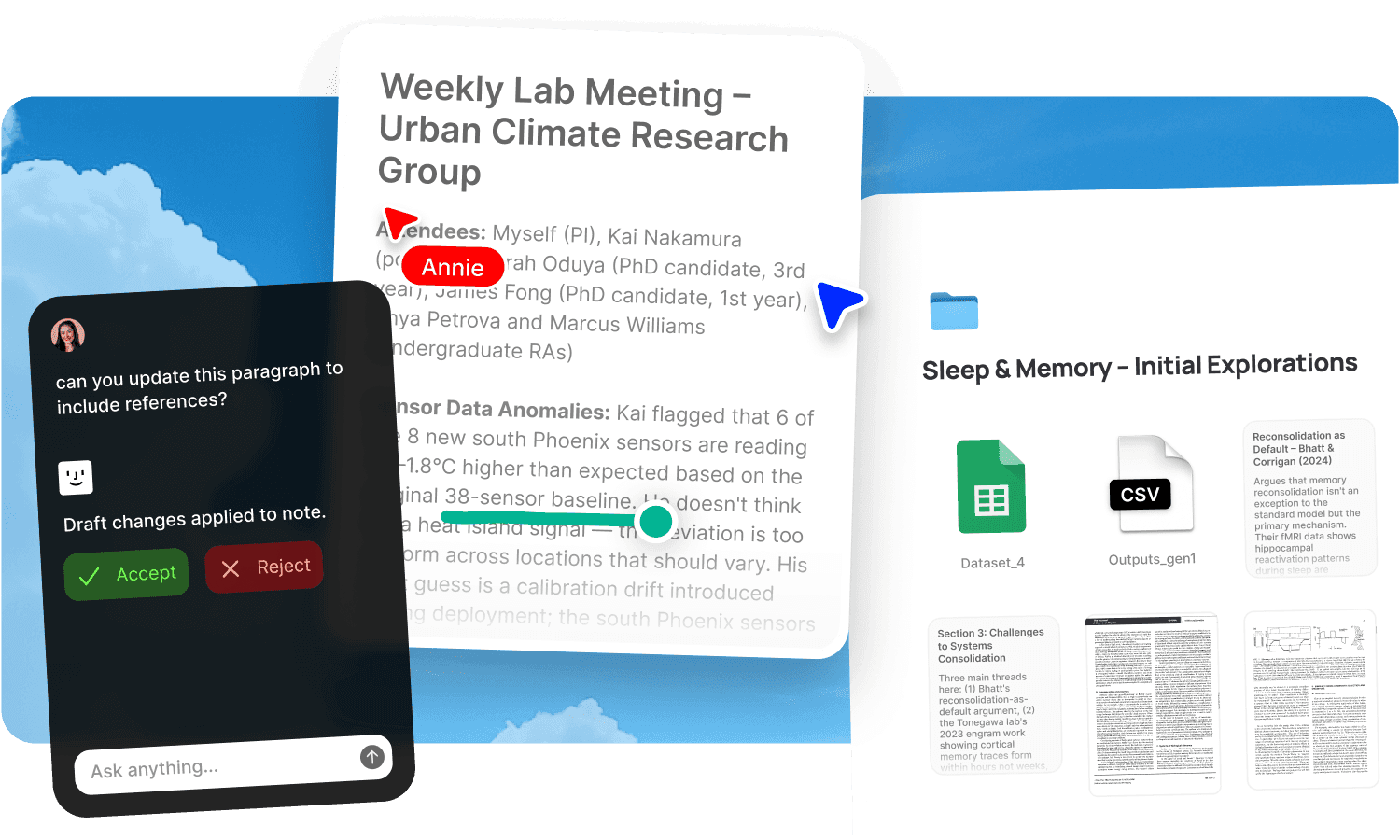
A lab generates years of accumulated knowledge: papers, datasets, experiment logs, supervisor meeting notes, conference recordings, grant applications, ethics submissions, protocol documents. Most of it is inaccessible to anyone who wasn't there when it was produced. The postdoc who ran the cortisol assays in 2024 has left. The protocol is in a folder somewhere on a shared drive, maybe. The methodology discussion from a lab meeting eighteen months ago was never written up. When a new PhD student joins, they inherit a Dropbox folder and a promise that someone will explain things eventually. The lab's institutional memory lives in the heads of people who keep graduating.
Fabric holds the full history of your lab's work and makes it searchable by any member, with self-writing docs that build the research record automatically and agents that handle the operational overhead of running a lab.
AI search with cited answers across the lab's history
AI search lets any lab member ask "what protocols did we use for the cortisol assays in 2024" or "papers we've cited on attentional control" and get cited answers spanning PDFs, notes, and recorded meetings, linked to the exact page or timestamp. The search works by meaning, not keyword, so it finds relevant material even when the terminology has shifted or different members described the same concept differently.
The AI assistant synthesises across the lab's full knowledge base. Ask it to pull together every finding related to a specific variable across years of experiments, compare methodologies across studies, or find the meeting where a specific analytical decision was made. It cites every source.
For literature specifically, see literature review and research projects.
Self-writing docs that build the research record
Self-writing docs connect to your meetings and workspace activity, and produce living documentation without anyone stopping to write it:
A user research repository that builds itself from recorded sessions, notes, and team discussions: methodology notes assembled from lab meetings, synthesised findings from experiment discussions, supervisor feedback captured and filed automatically.
A decision log tracking analytical choices, methodological pivots, and design decisions as they're discussed in meetings and channels. When a reviewer asks "why did you use this method," the answer is already documented.
The docs appear within 24 hours and update continuously. The research record reflects what your lab is actually doing and deciding, assembled from the work itself.
Agents that flag, extract, and coordinate
Agents go beyond retrieval. They act on behalf of the lab:
One monitors RSS feeds and preprint servers and flags new papers relevant to your research focus, dropped into a shared channel or space.
Another reads your supervisor meeting recording, extracts the action items, and creates tasks for each lab member with deadlines.
Another pulls together a weekly lab digest from everyone's activity so the PI stays current without scheduling another meeting.
The research stays human. The coordination overhead doesn't have to be.
New members inherit the full knowledge base
When a new PhD student or postdoc joins, they don't start from zero. The lab's full history is searchable from day one: every paper, every protocol, every meeting transcript, every decision. They ask the AI assistant questions and get cited answers drawn from the lab's actual work, not a stale onboarding doc someone wrote three years ago.
For structuring the onboarding experience, see onboarding new team members and the guide to onboarding collaborators.
Annotate and connect across sources
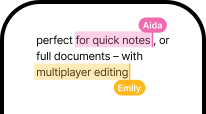
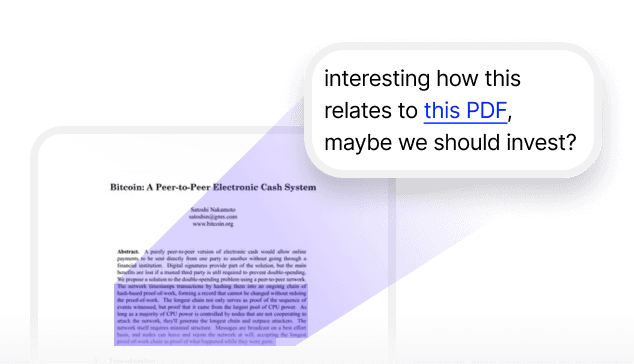
Annotations let lab members highlight, comment, and discuss directly on papers, protocols, and documents. The annotations are searchable, so a methodological note pinned to a paper two years ago is findable when the question comes up again.
The explorer and similar search surface connections between papers, notes, and experiment records that span different projects and different lab members' work. The connections form by content, not by folder structure.
Use the canvas for spatial research planning: map literature landscapes, arrange findings, and plan study designs visually with real-time collaboration.
Who in the lab uses Fabric
Researchers manage papers and synthesis across projects. Students work on dissertations and studying with the lab's full library searchable alongside their own notes. Educators connect their teaching materials to their research. User researchers build interview repositories with AI synthesis.
For structured research approaches, see the guides to research workflow, dissertation workflow, and literature review.
Get started
Give your lab a knowledge base that builds itself and makes years of accumulated work searchable by anyone. Try Fabric free. See pricing for teams.
FAQs
Can any lab member search across the full history?
Yes. AI search reads inside every paper, protocol, note, and meeting transcript and searches by meaning. Any member can ask a question and get cited answers linked to the exact source.
What are self-writing docs?
Self-writing docs connect to your lab's meetings and workspace activity and produce documentation automatically: research repositories, decision logs, methodology notes. They write themselves from your actual discussions and work.
Can agents flag new papers relevant to our research?
Yes. Agents can monitor RSS feeds and preprint servers and flag papers matching your research focus, delivered to a shared space or channel.
Can agents extract action items from supervisor meetings?
Yes. An agent reads the meeting recording, extracts action items, and creates tasks for each lab member with deadlines.
Can new PhD students search the lab's history from day one?
Yes. The full knowledge base is searchable immediately. New members ask questions and get cited answers from the lab's papers, protocols, meetings, and decisions, without a separate onboarding process.
Does the decision log update automatically?
Yes. The decision log captures methodological and analytical decisions from meetings and discussions. When a reviewer asks why you chose a method, the answer is already documented with context.
Can we annotate papers and protocols together?
Yes. Annotations let any lab member highlight and comment on papers, protocols, and documents. Annotations are searchable and visible to the team.
Can we plan research visually?
Yes. The canvas supports spatial research planning with real-time collaboration. Map literature, arrange findings, and plan study designs together.
What tools does Fabric connect to?
Fabric connects to Google Drive, Dropbox, Notion, Gmail, Slack, and meeting tools. See connections for the full list.
Is our research data secure?
Yes. Fabric uses AES-256 encryption and is CASA Tier 2 compliant. Your lab's data is never used to train AI models.
How is this different from a shared Google Drive?
Google Drive stores files by name and folder. Fabric reads inside every file and searches by meaning with cited answers, produces self-writing documentation from your meetings and activity, and gives you agents that flag papers, extract action items, and coordinate the lab. The difference is between a file server and a living knowledge base.