Every meeting produces decisions and action items that die in a Google Doc nobody opens again.
Fabric transcribes, identifies what matters, and updates the relevant project pages. Not a generic summary. Specific decisions filed where they belong.
Meetings that actually produce something.
Automatic transcription.
Fabric transcribes your meetings in the background. No meeting bot joining the call, no awkward "is everyone okay with recording," no manual transcription afterwards. Record in Fabric and the transcript is ready when the meeting ends.
Decisions and action items extracted.
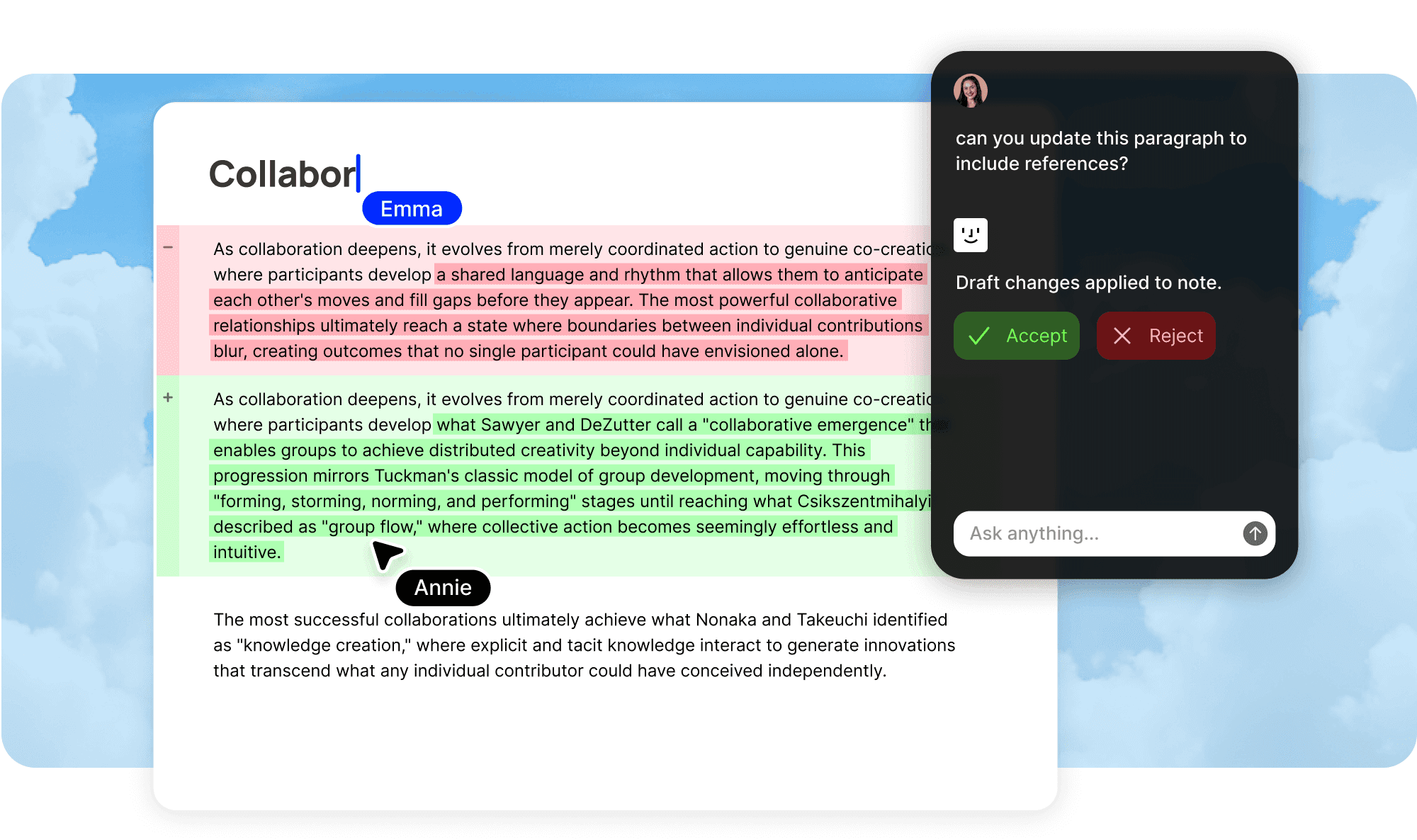
Fabric does not just produce a transcript. It reads the conversation and identifies what was decided, what actions were agreed on, and what context was shared. These are extracted as structured documentation, not buried in a wall of text.
Filed where they belong.
A product decision goes to product docs. An engineering trade-off goes to engineering docs. A client commitment goes to the client tracker. An action item goes to tasks. Fabric understands which project, topic, or relationship the discussion relates to and files each piece of knowledge in the right place.
Beyond the summary.
Your notes, merged in.
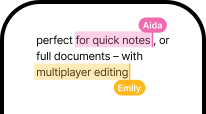
If you take notes during the meeting using Fabric's meeting notepad, your notes are merged with the transcript in the final document. The things you thought were important and the things the AI identified as important are combined into one complete record.
Connected to other sources.
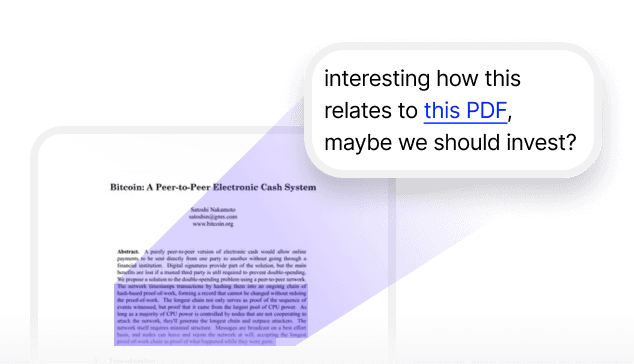
A meeting decision that follows up on a Slack discussion is documented with that context. A meeting that results in a GitHub PR gets linked to the documentation that PR produces. Meetings do not exist in isolation, and the documentation they produce should not either.
Recurring meetings tracked over time.
Weekly standups, monthly reviews, and regular client calls produce documentation that builds on itself. Fabric tracks how discussions evolve across meetings, so your documentation reflects the full arc of a project or relationship rather than treating each meeting as a standalone event.
The meeting notes problem.
Every organization has the same meeting notes failure mode. Someone takes notes in a Google Doc or Notion page during the meeting. The notes are shared afterwards. Maybe one or two people glance at them. Then the document is never opened again. Three weeks later, someone asks what was decided in that meeting and nobody can find the notes, or finds them but they are too sparse to be useful. The decisions made in that meeting are effectively lost.
The problem is not that people fail to take good notes. It is that meeting notes as a format are broken. A single document capturing everything discussed in a one-hour meeting is too long to re-read and too unstructured to search. The decision about the pricing model is buried between a discussion about the office holiday party and a question about a bug in staging. Even if someone does find the doc, they have to read through the whole thing to extract the one piece of information they need.
Decisions belong in context, not in a meeting doc.
Fabric approaches meetings differently. Instead of producing a single meeting summary document, it identifies the individual decisions, action items, and knowledge shared during the meeting and files each one where it belongs in your existing documentation. The pricing decision goes to product docs. The engineering trade-off goes to engineering docs. The client commitment goes to the client relationship tracker. The action items become tasks.
This means you never have to search through meeting notes to find a decision. You search for the decision itself, or you browse the relevant documentation page, and the meeting context is there alongside everything else related to that topic. The AI assistant can answer questions about meeting decisions with timestamped citations pointing to the exact moment in the recording where the topic was discussed.
Every meeting makes the docs better.
Traditional meeting notes are write-once artifacts. Fabric's approach is cumulative. Every meeting that touches on a project, a client relationship, or a technical system adds to the documentation for that topic. A weekly standup where the team discusses a migration adds new context to the migration's engineering docs. A monthly client review updates the client tracker with the latest status and decisions. The documentation gets richer and more complete over time, assembled from dozens of meetings without anyone writing a single page manually.
For startups where decisions happen fast and in lots of small meetings, this compounding effect is especially valuable. A year of weekly team meetings produces a comprehensive decision log that captures the full history of how the company evolved. New hires can read through months of documented decisions and understand not just how things work today but how and why they got here. See how Fabric supports onboarding.
No meeting bot required.
Most meeting transcription tools work by adding a bot to your video call. This creates friction: someone has to invite the bot, participants may be uncomfortable with an unfamiliar recorder joining, and the bot itself can be disruptive. Fabric works differently. You record the meeting directly in Fabric, using whatever setup works for your team. There is no bot joining your Zoom, Google Meet, or Teams call. The recording is processed after the meeting, and documentation appears in your workspace. You can also record voice notes for informal conversations and one-on-ones that do not happen on a video platform.
What gets captured from meetings.
Decisions
What was decided, by whom, and the reasoning discussed. Filed as decision records in the relevant project or topic area.
Action items
Commitments and next steps identified during the meeting. Can be created as tasks with assignees and due dates.
Project updates
Status updates, blockers, and progress discussed during the meeting are filed as project documentation.
Client context
Discussions about client relationships, deliverables, and commitments are filed in the client tracker. Every client call adds to the client's documentation automatically.
Technical context
Architecture discussions, technical trade-offs, and implementation decisions are filed in engineering docs. Connected to any PRs that implement the decision.
Use cases
Weekly standups and syncs
Stop losing decisions and context from recurring meetings. Each standup adds to your documentation rather than producing another Google Doc that nobody revisits. See how Fabric supports meeting notes.
Client calls
Every client meeting updates the client relationship tracker with decisions, commitments, and open items. Walk into the next call with full context without anyone updating a CRM. See how Fabric supports client work.
Product and planning meetings
Feature decisions, roadmap discussions, and prioritization outcomes are filed in product docs. The meeting where you decided to cut a feature is documented alongside the feature itself.
Research interviews
User interviews, stakeholder conversations, and expert sessions are transcribed and their insights filed in your user research repository. Findings accumulate across sessions automatically. See how Fabric supports research.
Perfect for
Startups
Fast-moving teams hold lots of small meetings where important decisions happen quickly. Fabric ensures those decisions are documented without slowing anyone down. Learn more about Fabric for startups.
Agencies and consultancies
Client calls are where commitments are made and relationships are shaped. Fabric captures that context and files it per client so your team always has the full picture before the next conversation. Learn more about Fabric for agencies.
Research teams
Interviews and research discussions produce insights that need to be captured precisely. Fabric transcribes, extracts findings, and builds your research repository from every session. Learn more about Fabric for research teams.
Product teams
Product decisions happen in meetings constantly. Fabric captures them and builds product documentation that reflects the full history of how your product evolved, not just the latest spec.
Works seamlessly with other features.
Slack and Discord follow-ups
Meeting decisions that continue in Slack or Discord threads are connected. The discussion and the resolution are documented together regardless of where they happened.
GitHub implementation
Technical decisions from meetings that result in PRs are linked to the code changes that implement them. The documentation captures both the why and the what.
Audio and video transcription
Meeting recording uses Fabric's transcription engine with timestamped, searchable output. The AI assistant can cite the exact moment something was discussed.
Tasks and reminders
Action items from meetings can become tasks with due dates, priorities, and connected files. Follow-through is tracked alongside the decision that created the action item.
FAQ
How do I record a meeting in Fabric?
Start a recording in Fabric during your meeting. You can record audio from any call or in-person conversation. There is no bot that joins your video call. See the meeting notepad guide for details.
Can I take notes during the meeting?
Yes. Fabric's meeting notepad lets you take notes while recording. Your notes are merged with the AI-generated transcript and extracted decisions in the final document.
Does Fabric just produce a meeting summary?
No. Fabric goes beyond summaries. It identifies individual decisions, action items, and knowledge from the meeting and files each one in the relevant location in your documentation. A pricing decision goes to product docs, not a generic meeting summary page.
What happens to the full transcript?
The full transcript is saved and searchable in your workspace. You can search for any word or phrase spoken during the meeting and jump to that exact moment in the recording. The transcript exists alongside the extracted decisions and context.
Does it work with Zoom, Google Meet, and Teams?
Fabric records audio directly rather than joining your call as a bot. This means it works with any video conferencing platform, any phone call, or any in-person conversation where you can record audio.
How does it handle recurring meetings?
Fabric tracks recurring meetings over time. Documentation from weekly standups, monthly reviews, and regular client calls builds cumulatively. Each meeting adds to the existing documentation rather than producing a disconnected standalone summary.
Can the AI assistant answer questions about my meetings?
Yes. Your AI assistant can search across all meeting transcripts and documentation, answer questions about what was decided, and cite the exact timestamp where a topic was discussed.
How is this different from Otter.ai, Fireflies, or Fathom?
Those tools produce meeting transcripts and summaries. Fabric produces documentation. The difference is that Fabric does not just tell you what was said. It identifies what matters and files it where it belongs in your existing docs. Decisions go to decision logs. Action items go to tasks. Client context goes to client pages. See how Fabric compares to Otter.ai, Fireflies, Fathom, and Granola, or browse the best AI meeting note takers.
Can I process meetings I have already recorded?
Yes. Upload existing audio or video recordings to Fabric and they will be transcribed and processed for documentation the same way live recordings are.
Which plans include meeting integration for self-writing docs?
Self-writing docs from meetings is available on Team plans. See team pricing for details.