Made for research teams
Fabric for research teams
A shared library where papers, notes, data, and findings are all searchable by meaning, with AI that surfaces cross-team connections.
Research teams produce knowledge faster than any individual can track. A postdoc reads forty papers and annotates the important ones. A PhD student runs experiments and logs the results. A PI reviews drafts and has conversations that reframe the direction. A collaborator at another institution sends data that complicates the hypothesis. All of this is knowledge. And in most labs and research groups, it's scattered across personal drives, email inboxes, reference managers, and the memories of people who might move on next year. The team collectively knows far more than any member individually, but there's no way to search across what the team knows. A paper one person read last year might directly contradict the assumption another person is building on today, and neither of them would ever find out.
Fabric gives research teams a shared library where every paper, note, annotation, data set, meeting record, and finding is searchable by meaning, with an AI that surfaces connections across the team's collective knowledge.
One searchable library for the whole team
Research materials scatter by default. Each team member saves papers in their own reference manager, writes notes in their own app, and keeps data on their own machine. The team's collective reading and thinking exists in fragments that nobody can query.
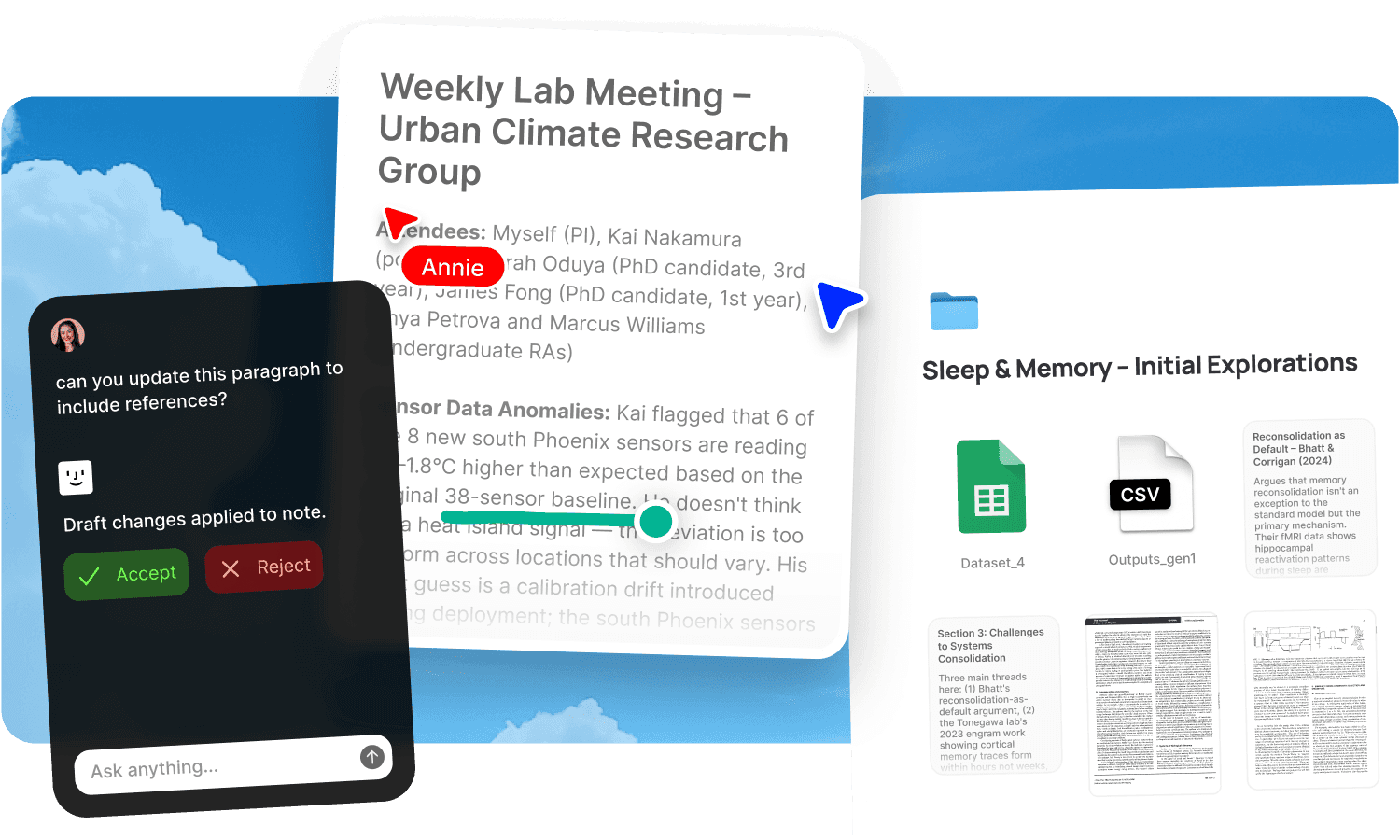
A shared Fabric space brings it all together. Papers, annotations, notes, drafts, data files, presentation slides, and meeting transcripts all live in one place, searchable by meaning with AI search. Ask "what has the team found about protein folding stability under heat stress" and get results from across everyone's papers, annotations, and notes, regardless of who saved them or when.
The AI assistant synthesises from the team's full library. Ask it to summarise the group's collective findings on a topic, identify where team members' sources disagree, or pull together the evidence base for a claim in a draft. It draws on everything the team has saved, not just what one person remembers.
Connections that cross individual silos
The most valuable research insights often happen between people's work, not within it. One team member's reading connects to another's experiment. A finding from a collaborator's data set illuminates a pattern in the literature. These connections are invisible when everyone's material lives in separate systems.
Fabric's explorer and similar search surface relationships across the shared library. When a team member saves a new paper, Fabric can show what else in the library relates to it, including material saved by other team members months ago. The cross-pollination that usually depends on serendipitous conversation becomes something the system can surface.
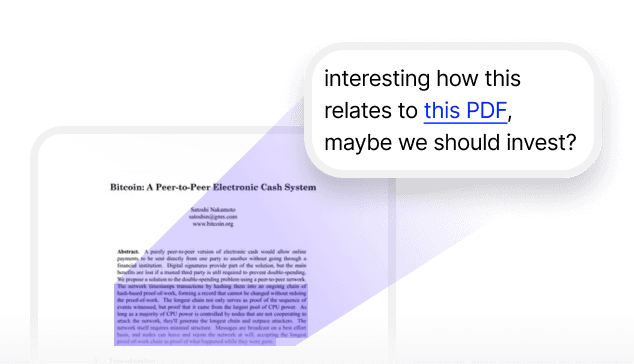
Annotations deepen this. When team members annotate papers and documents with their own thinking, those annotations become searchable across the team. A comment one person made on a paper six months ago is findable by another person today, which is the kind of knowledge sharing that doesn't happen through shared drives.
Capture the team's thinking, not just its files
Research knowledge isn't only papers and data. It's also the conversations in lab meetings, the reasoning behind a method choice, the hypothesis that was considered and rejected, the supervisor's feedback on a draft. Most of this evaporates because it's spoken, not written.
AI voice notes capture and transcribe lab meetings, supervision sessions, and research discussions. The transcript lands in the shared space, searchable alongside papers and notes. When someone later asks "why did we switch from method A to method B," the answer is in the recording from the meeting where it was discussed, findable by searching the question.
Notes and docs are where the team writes together: research logs, method notes, draft sections, and internal memos. Because they live in the same library as the papers and data, the thinking that produces a finding stays connected to the evidence behind it.
Share and publish with control
Research teams share material constantly: with collaborators, with funders, with reviewers, with the public. Each audience needs different access and different levels of control.
Publish any document or collection with a shareable link. Add password protection for material that shouldn't be public. Use link analytics to track when collaborators or funders have accessed shared material.
For pre-publication work, sensitive data, or material under review, the access controls ensure that only the right people can see the right documents. For public-facing research outputs, published links give collaborators and the wider community a clean, always-current view of what you've shared.
Use cases for research teams
The workflows research teams run in Fabric: running literature reviews across the team's collective reading, managing ongoing research projects with shared sources and synthesis, maintaining project documentation that captures decisions and rationale, capturing meeting notes from lab meetings and supervisions, building a team wiki for methods, protocols, and know-how, onboarding new team members into the group's research and practices, brainstorming on the canvas for spatial thinking about problems, and building a second brain for the team's accumulated knowledge.
For structured research approaches, see the guides to research workflow and literature reviews.
A research team's day in Fabric
Morning. A PhD student finds a new paper that challenges the group's working hypothesis. She saves it to the shared space and annotates the key claims. Similar search surfaces three papers another team member saved last year that make related arguments. She hadn't seen them.
Mid-morning. The PI asks the AI assistant to pull together everything the team has collected on a specific mechanism. It synthesises across papers, annotations, and notes from four team members, producing a summary with citations to the source material.
Lunch. The group holds a lab meeting. A postdoc records it with voice notes. The transcript joins the shared library. When they revisit a decision made in this meeting weeks later, they search for it rather than relying on memory.
Afternoon. A visiting collaborator needs access to the team's data and methods for a joint paper. The PI publishes the relevant collection with a password-protected link and shares it. Link analytics show when the collaborator has accessed the material.
End of day. A new master's student joining the group searches the shared library for the team's key papers and asks the AI to summarise the group's main research questions and current findings. She's oriented in an afternoon rather than spending her first month piecing together context from conversations.
Get started
Give your research team a shared library where collective knowledge is searchable, connected, and retained. Try Fabric free.
See pricing for teams. For individual researchers managing their own reading and projects, see Fabric for researchers. For student research groups, see the group projects use case.
FAQs
Can the whole team search across all shared papers and notes?
Yes. A shared Fabric space gives every team member access to the same searchable library. AI search finds material by meaning across everyone's contributions, regardless of who saved what or when.
Can the AI synthesise findings across the team's research?
Yes. The AI assistant draws on everything in the shared library. Ask it to summarise collective findings, identify disagreements between sources, or pull together the evidence base for a specific claim.
Do annotations from team members become searchable?
Yes. Annotations made by any team member on any paper or document are searchable by the whole team. A comment one person made on a paper months ago is findable by anyone searching for that concept.
Can we record and transcribe lab meetings?
Yes. AI voice notes capture and transcribe meetings, supervisions, and research discussions. The transcript becomes a searchable part of the shared library.
Can we find connections between papers saved by different team members?
Yes. The explorer and similar search surface relationships across the shared library. When one person saves a paper, the system shows related material from the whole team's collection.
Can new team members get up to speed on the group's research?
Yes. A new member searches the shared library and asks the AI to summarise the group's key questions, methods, and findings. The briefing draws on the full history of the team's work.
Can we share research with collaborators at other institutions?
Yes. Publish documents or collections with a password-protected link. Track access with link analytics. The collaborator doesn't need a Fabric account to view published material.
Does Fabric replace our reference manager?
Fabric isn't a citation-formatting tool. It complements reference managers like Zotero or Mendeley. You keep the reference manager for generating bibliographies and use Fabric as the shared space where the team reads, annotates, searches, and synthesises across papers.
Can we write research notes and drafts together?
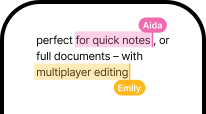
Yes. Notes and docs support collaborative writing with real-time collaboration including live cursors, threaded comments, and @mentions. Write alongside the papers and data the draft draws on.
Can we use the canvas for research planning?
Yes. The canvas lets the team spread papers, notes, and ideas spatially. Useful for mapping a research landscape, planning a study design, or brainstorming hypotheses.
Can we build a shared methods and protocols library?
Yes. Use a shared space as a team wiki for methods, protocols, standard procedures, and lab know-how. The AI searches across it alongside the research library, so relevant protocols surface when the team needs them.
Is our research data private and secure?
Yes. Fabric uses AES-256 encryption, is CASA Tier 2 compliant, and does not use your data to train AI models. Access is controlled per space.
Can we import existing papers and notes from other tools?
Yes. Fabric connects to Google Drive, Dropbox, and Notion. Bring in existing research materials without starting over.